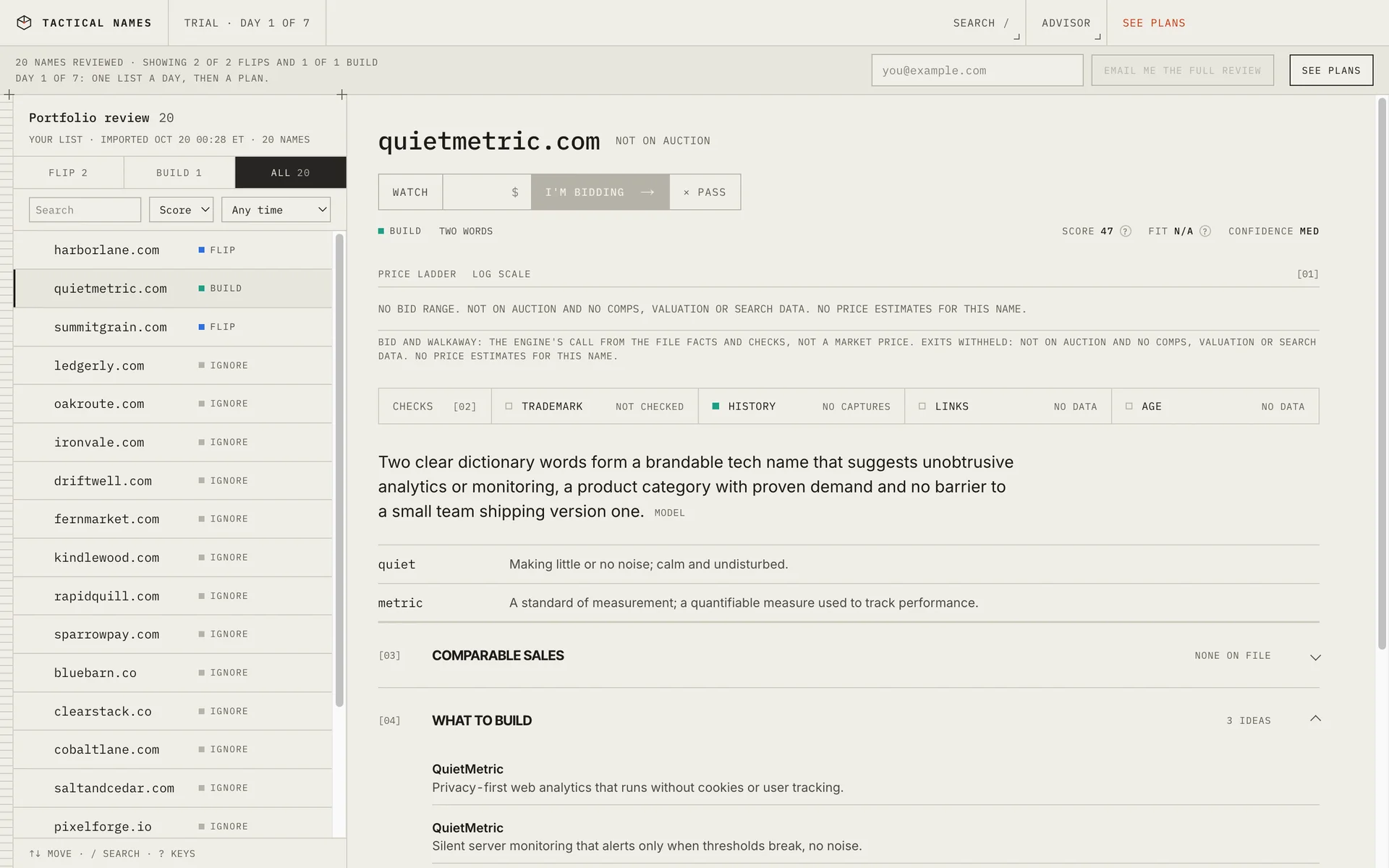
What I set out to do
I have sold domain names for six figures, and I have also bought plenty I shouldn’t have. Every morning, GoDaddy auctions off nearly a million expiring domains. Somewhere in that massive inventory are names worth buying, but finding them before the clock runs out means scrolling through an endless spreadsheet, relying more on raw instinct than actual analysis.
I built Tactical Names to do the heavy lifting. The tool filters out the noise, isolates the highest-value candidates, and establishes a clear data framework to help investors decide what to ignore, buy to resell, or hold to build a business around.
- Role
- Product designer, builder, and first customer
- Timeline
- August to October 2026
- Team
- Claude (development and research)
- Status
- Live and charging $39/mo and $129/mo with a 7-day trial
01 / ORIGIN
Turning domain-buying instincts into a repeatable process
I spent years developing personal rules for evaluating domains: shorter is better, real words beat invented ones, and a name must be easy to spell. Manually applying these constraints to thousands of expiring names daily was impossible. Fatigue quickly sets in, causing you to rely on raw instinct and forget that a promising asset at $500 can be a devastating investment at $15,000.
I partnered with my buddy Claude to translate these implicit heuristics into a programmatic process. We quickly realized a simple numerical quality score was not enough. To make smart acquisitions, I needed an interface that could instantly estimate a realistic maximum bid, flag when to walk away, and explicitly detail whether a name holds more value as a resale asset or a business foundation.
02 / EXPERIENCE
Turning thousands of names into a few good decisions
I did not need a language model to evaluate every single domain. Most initial filtering happens faster and cheaper with conventional scoring. A scoring engine processes the daily file in fifteen seconds, sending only the top three hundred candidates to the AI. When the database lacks enough historical sales to support a valuation, the model purposefully withholds the number rather than guessing. I would rather show uncertainty than an un backed figure.
The interface is explicitly designed to help investors spot valuable names instantly. The first iteration packed the score, recommendation, bidding range, and time remaining into a single row, creating too much data to scan comfortably. To fix this, I stripped the primary list view down to the essentials: domain name, direct recommendation, and time left. Individual scores and deep textual explanations moved cleanly into a dedicated detail drawer.
03 / DECISIONS
Knowing when to start over
After two months of iteration, Tactical Names worked but had become increasingly complicated. I experimented with two conversation-first versions featuring an active chat assistant, but neither felt right. After doing the math, I realized the conversational feature was incredibly expensive to run. The core value of the tool lies in the structured data already on display, so I cut the chat entirely and rebuilt the interface around a clean, data-first brief.
Rebuilding the product also allowed me to fix critical onboarding and micro-interaction friction. I replaced the standard marketing page with an instant trial where users paste a list without an account to preview ten resale and build opportunities. I also designed a separate Passed view to isolate automated engine rejections from personal human choices, and replaced the misleading Bid button with an I’m bidding toggle to log auction intent without implying an internal transaction occurred.
Tactical Names is live with paid subscriptions, a daily analysis pipeline, and an instant trial designed to demonstrate clear value.
The primary challenge now is distribution. Having built a solution to a problem I know firsthand, my focus is shifting from engineering utility to reaching other investors and helping them make better acquisition decisions.
From idea to production, with AI as a collaborator.
I partner with AI across the product lifecycle as a rigorous collaborator. I expect models to challenge my decisions and expose trade-offs, not simply agree with me. While independent agents accelerate our build and verification loops, human governance remains absolute. AI creates massive operational velocity, and my responsibility is ensuring that speed moves the product in the right direction.
Discover
Understand the problem
01 /Step 1: Frame the idea
Problem, audience, desired outcome
02 /Step 2: Explore together
Questions, alternatives, tradeoffs
03 /Step 3: Validate assumptions
Research, feasibility, evidence (AI research - I decide)


Define
Set the direction
04 /Step 4: Define the product
Requirements and success criteria
05 /Step 5: Plan the work
Milestones, tasks, acceptance tests. AI drafts
06 /Step 6: Approve the plan
I revise scope before work begins. My approval.
Deliver
Build, verify, release
07 /Step 7: Build + review loop
Implement, agent audit, fix, recheck (AI and agents)
08 /Step 8: Connect + test
Services, env setup, staging QA
09 /Step 9: Ship + learn
I approve release; we iterate. My approval
If you’re interested in working with me, please contact sincerelyjorge@gmail.com.
Have we met? Let’s connect on LinkedIn. Lurking? See you on X. Either way, thank you for stopping by.