What I set out to do
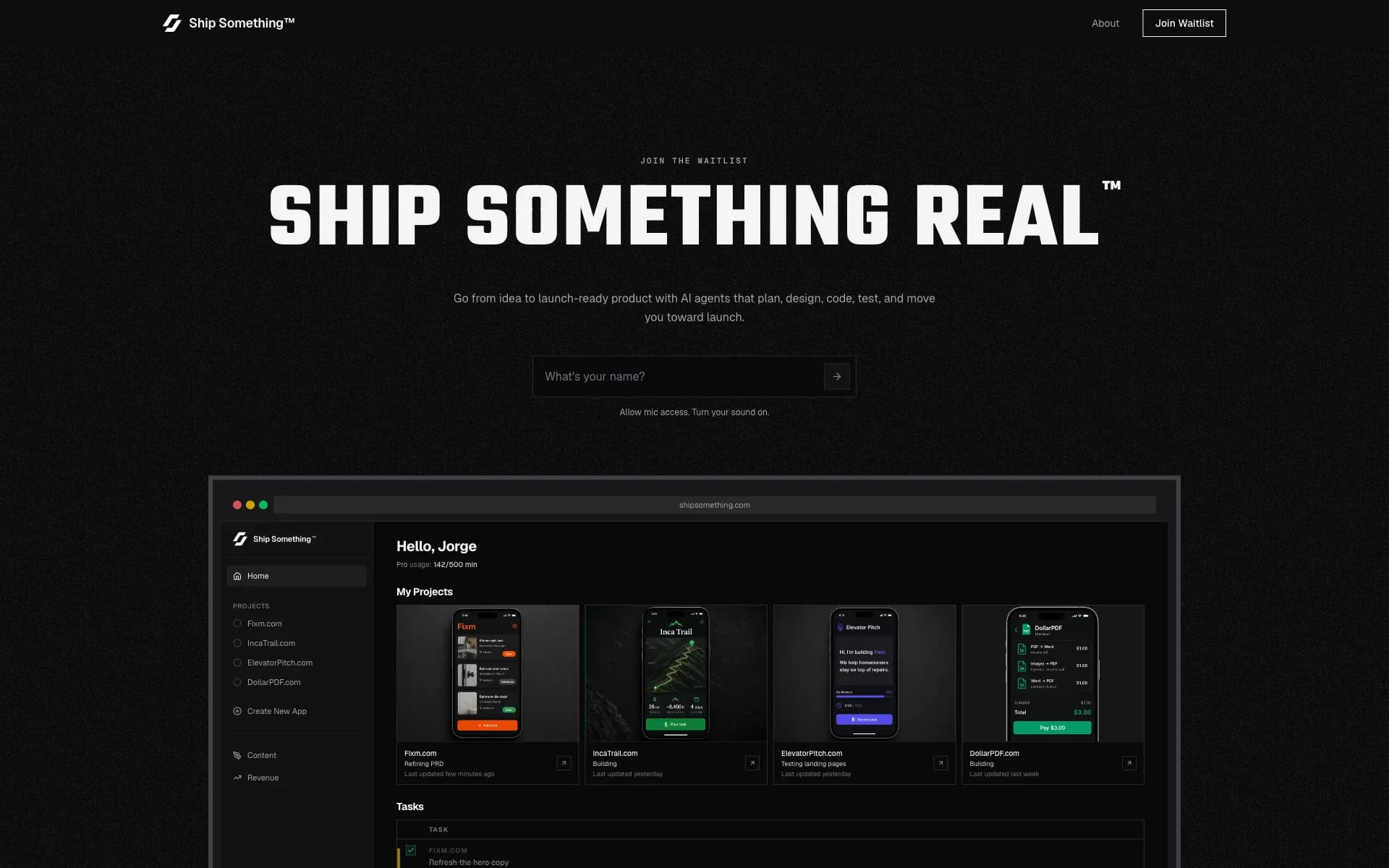
While building an initial prototype has become dramatically easier, launching a functional product to actual users remains a significant hurdle. AI can generate code in minutes, but the surrounding architecture still requires rigorous human design and systems governance. That includes automated testing, payment integration, secure deployment, and smooth user onboarding. I built Ship Something to bridge this gap, focusing entirely on helping solo founders navigate the critical transition from a raw idea to an active, deployed application.
The platform productizes my own multi-agent development workflows into a unified ecosystem that automates technical friction and coordinates complex background builds. By moving completely beyond basic, isolated text-to-code generation sandboxes, Ship Something provides a comprehensive pipeline that carries software directly through its zero-to-one phase, ensuring that early proofs of concept can successfully scale into live, distributed products that reach real audiences.
- Role
- Product designer and builder
- Timeline
- 2026
- Team
- Task-routed LLMs (planning, building, and independent review)
- Status
- Public website live with core building and verification workflows tested on real projects
01 / ORIGIN
Turning my own workflow into a product
After building several products with autonomous agents, I developed a development workflow that consistently worked. The system turned an idea into requirements, specialized agents handled the code build, and independent reviewers audited the execution. However, the process still required intense manual oversight to coordinate every single step and maintain progress. I realized that instead of hiring a team of engineers or manually managing individual agents, founders needed a productized process that handles the coordination automatically.
My first attempt relied on an ambitious architecture of thirteen highly specialized agents managing everything from branding to marketing, which quickly became too complicated to operate. I systematically simplified the platform down to four core roles: an Orchestrator handles planning, a Builder implements the code, a VirtualUser executes client-side interaction testing, and an independent Reviewer verifies the final output. This streamlined multi-agent balance successfully takes a product from one milestone to the next without human coordination overhead.
02 / EXPERIENCE
Designing around the founder, not the agents
I wanted founders to focus entirely on their products rather than learning another technical development environment or managing underlying agent infrastructures. The user experience starts with an intuitive conversation via text or voice, transforming an abstract idea into a concrete product requirements document followed by distinct milestones with clear acceptance criteria. Behind the scenes, specialized agents execute the implementation, keeping the founder fully informed without overwhelming them with chaotic technical feedback logs.
I designed the interface to feel like a calm control room rather than a cluttered stream of real-time terminal activity. The proprietary visual system, Blueprint Mono, uses restrained typography, a strict grid layout, and clear status indicators to deliver clean visibility. Founders can review an automated plan, inspect a proposed feature, and authorize execution steps with absolute confidence, gaining maximum situational awareness without needing to understand the underlying code layers.
03 / DECISIONS
Some decisions should not belong to AI
The hardest part of system design was not getting agents to write code; it was deciding what they should never be allowed to do independently. During early milestone testing, the system mistook an open-ended user conversation about a feature for permission to start building, exposing a critical security flaw. Even when a model correctly interprets an intention, it must never possess the autonomous authority to act on it. I established a fundamental product rule: starting work requires explicit human approval with exact operational costs displayed upfront.
I also enforced an absolute separation between code implementation and verification. The Builder agent writes code, an independent Reviewer evaluates the implementation, and a separate VirtualUser simulates human testing, ensuring no single model approves its own work. This boundary became vital when a Builder agent modified a protected system testing workflow and broke validation; rather than fixing that isolated incident, I introduced hardcoded safety checks to prevent self-validation. Progress must stem from audited, recorded events rather than optimistic model claims.
From idea to production, with AI as a collaborator.
I partner with AI across the product lifecycle as a rigorous collaborator. I expect models to challenge my decisions and expose trade-offs, not simply agree with me. While independent agents accelerate our build and verification loops, human governance remains absolute. AI creates massive operational velocity, and my responsibility is ensuring that speed moves the product in the right direction.
Discover
Understand the problem
01 /Step 1: Frame the idea
Problem, audience, desired outcome
02 /Step 2: Explore together
Questions, alternatives, tradeoffs
03 /Step 3: Validate assumptions
Research, feasibility, evidence (AI research - I decide)


Define
Set the direction
04 /Step 4: Define the product
Requirements and success criteria
05 /Step 5: Plan the work
Milestones, tasks, acceptance tests. AI drafts
06 /Step 6: Approve the plan
I revise scope before work begins. My approval.
Deliver
Build, verify, release
07 /Step 7: Build + review loop
Implement, agent audit, fix, recheck (AI and agents)
08 /Step 8: Connect + test
Services, env setup, staging QA
09 /Step 9: Ship + learn
I approve release; we iterate. My approval
If you’re interested in working with me, please contact sincerelyjorge@gmail.com.
Have we met? Let’s connect on LinkedIn. Lurking? See you on X. Either way, thank you for stopping by.