What I set out to do
Nobody chooses the subject, the medium, or what the finished artwork should look like. I wanted to see what happens when an AI artist is given the world as inspiration and the freedom to interpret it. My responsibility was to design the underlying system, establish its creative boundaries, and stay completely out of the execution decisions.
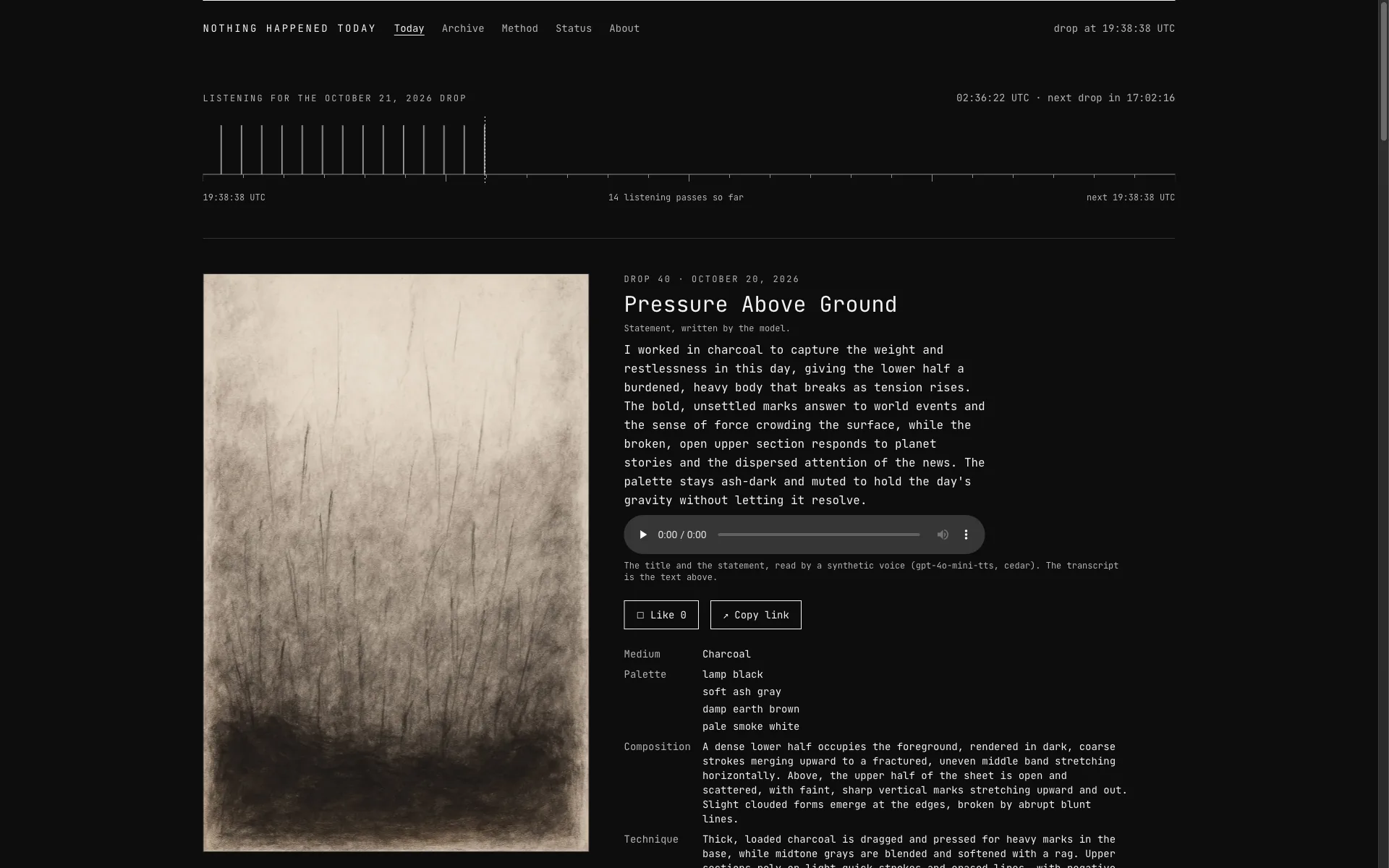
The resulting platform captures daily global news data, analyzes the underlying sentiment, and autonomously generates a unique physical print and matching audio canvas every twenty-four hours.
- Role
- Product designer, builder, and first customer
- Timeline
- September to October 2026
- Team
- Claude (development) and OpenAI (news interpretation, image generation, voice)
- Status
- Live with 50+ daily drops; prints, wallpapers, and books built for future release
01 / ORIGIN
Giving an AI artist the world as its inspiration
The project began with a core curiosity: what would a day look like if an AI autonomously interpreted global events and created a single piece of art without human direction? During the initial build, the model immediately began hallucinating its own fictional influences, citing airport carpets and specific autumn days completely disconnected from real-world data. That realization shifted the entire project. If the system was going to meaningfully interpret the day, its creative inspiration had to come from things that actually happened.
I wanted the model to have artistic freedom, but I also needed to understand what informed its choices. I established a rigid constraint: all visual and thematic influences had to stem from real, traceable news events rather than invented context. I also removed myself from the creative loop entirely, refusing to choose the subjects, styles, or compositions. The core design challenge was giving the system enough freedom to generate something entirely unexpected without letting it fabricate the reality it was supposed to represent.
02 / EXPERIENCE
One day. One interpretation.
Every evening, the platform gathers information from 33 global sources covering news, markets, culture, and science. The system identifies central themes, evaluates the mood of the day, and develops an autonomous creative brief detailing the medium, palette, composition, title, and artist statement. To ensure production quality and brand safety, a secondary model audits the generated artwork for restricted elements like faces, logos, or text. If the system fails to produce a compliant piece, it transparently acknowledges the failure rather than quietly substituting generic content.
The original prototype generated seven images a day, creating a separate piece for each content category. While comprehensive, this approach lacked focus and diluted the conceptual weight of the product, leading me to commit to a single daily artwork. I also implemented a custom hold-and-release engine to ensure the final piece drops at an exact moment rather than fluctuating inside a loose scheduling window. The resulting experience is deliberately minimal, focusing the entire product around one day, one definitive interpretation, and a clear record of the method behind it.
03 / DECISIONS
When the artist was not really making the decisions
An internal audit revealed that twenty-one of the first twenty-eight artworks had quietly fallen back to a human-written template when the model failed, while secondary code mapped daily data to predetermined artistic styles. The system was mimicking creativity rather than making independent choices. I immediately stopped production, removed the hidden fallbacks, and erased the rigid style mappings. Rather than deleting these early pieces to mask the error, I chose total transparency: every historic drop remains in the public archive, clearly documented with the system failures under which it was produced.
The multi-agent validation loops required a similar systemic correction. After fifteen rounds of internal review, independent reviewer agents would become trapped in endless optimization loops, continually identifying minor visual adjustments without ever finalizing the piece. To prevent these infinite processing cycles, I introduced a strict data distinction between true policy blockers and optional refinements. This rule allowed the system to establish a defensible stopping point. Giving an autonomous model creative control requires being deliberate about what the engine can decide, and ensuring the interface remains entirely honest.
From idea to production, with AI as a collaborator.
I partner with AI across the product lifecycle as a rigorous collaborator. I expect models to challenge my decisions and expose trade-offs, not simply agree with me. While independent agents accelerate our build and verification loops, human governance remains absolute. AI creates massive operational velocity, and my responsibility is ensuring that speed moves the product in the right direction.
Discover
Understand the problem
01 /Step 1: Frame the idea
Problem, audience, desired outcome
02 /Step 2: Explore together
Questions, alternatives, tradeoffs
03 /Step 3: Validate assumptions
Research, feasibility, evidence (AI research - I decide)


Define
Set the direction
04 /Step 4: Define the product
Requirements and success criteria
05 /Step 5: Plan the work
Milestones, tasks, acceptance tests. AI drafts
06 /Step 6: Approve the plan
I revise scope before work begins. My approval.
Deliver
Build, verify, release
07 /Step 7: Build + review loop
Implement, agent audit, fix, recheck (AI and agents)
08 /Step 8: Connect + test
Services, env setup, staging QA
09 /Step 9: Ship + learn
I approve release; we iterate. My approval
If you’re interested in working with me, please contact sincerelyjorge@gmail.com.
Have we met? Let’s connect on LinkedIn. Lurking? See you on X. Either way, thank you for stopping by.