What I set out to do
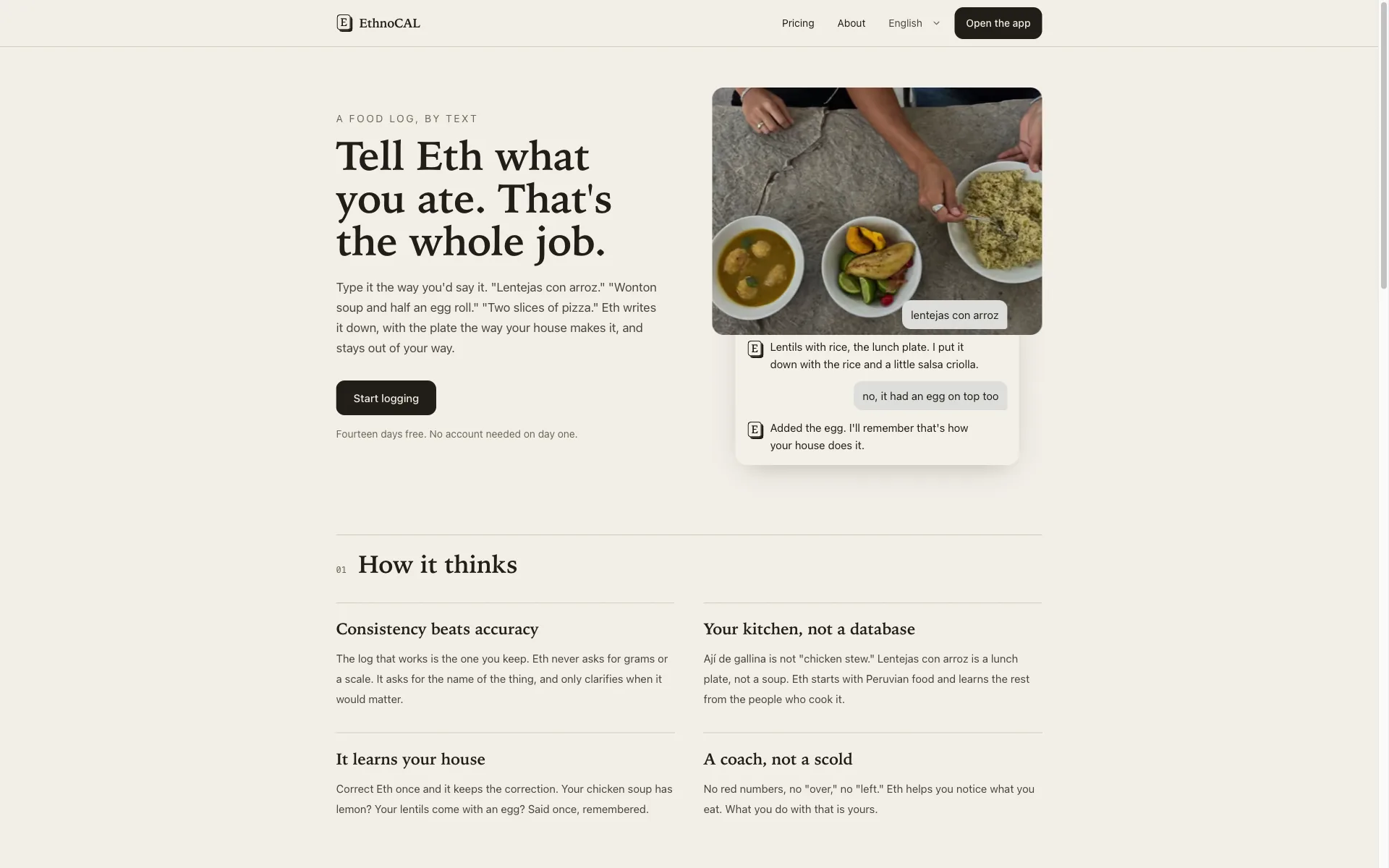
Every food tracker assumes a standard Western diet. For the meals I grew up eating, logging becomes a tedious exercise in guesswork. I built EthnoCAL to fix that.
It’s a multi-lingual, culturally inclusive catalog of dishes designed to make food logging feel familiar, accurate, and effortless.
- Role
- Product designer and builder; led the end-to-end product architecture and AI workflow
- Timeline
- September to October 2026
- Team
- Claude (development and conversational interpretation)
- Status
- Live in English and Spanish, with a focus on Peruvian food
01 / ORIGIN
Starting with how people actually eat
Every food tracker I tried misunderstood the meals I grew up eating. Lentejas con arroz became lentil soup; ají de gallina became chicken stew. Before I could log dinner, I had to translate it into something the app understood. That is why I built EthnoCAL to recognize meals the way people actually eat them, not just as a disconnected collection of ingredients.
I also questioned the industry’s obsession with absolute precision. A consistent estimate is infinitely more useful than a theoretically perfect number that requires so much effort people eventually quit. The goal wasn’t another calorie calculator, but a tool you can comfortably use every day without explaining your culture to it first.
02 / EXPERIENCE
Making logging feel like a conversation
The first version of EthnoCAL was photo-first, much like other nutrition apps. It functioned, but I wasn’t convinced it was the right experience. So I built a chat-first interface alongside it, and eventually chose the conversation. Logging should feel like telling someone about dinner rather than filling out a cold, multi-step interface form.
Instead of navigating rigid forms, you simply tell Eth what you ate in English or Spanish. The assistant dynamically parses the text to create a contextual meal card complete with a clear calorie estimate, portion sizes, and a transparent list of any underlying assumptions it made.
03 / DECISIONS
Knowing when AI should stay out of the way
One of the biggest decisions was figuring out what AI should actually handle. EthnoCAL uses a catalog for familiar dishes, with Claude interpreting less predictable conversations. The catalog, not the model, determines nutritional estimates. The system must be useful without trusting it to make every product decision.
Testing also exposed severe edge cases. A phrase like me corté abriendo una lata could trigger an incorrect crisis response, while an early test miscalculated a meal by counting the steak twice. I hardcoded sensitive responses using predefined language and wrote regression tests to ensure those critical logical errors won’t return.
From idea to production, with AI as a collaborator.
I partner with AI across the product lifecycle as a rigorous collaborator. I expect models to challenge my decisions and expose trade-offs, not simply agree with me. While independent agents accelerate our build and verification loops, human governance remains absolute. AI creates massive operational velocity, and my responsibility is ensuring that speed moves the product in the right direction.
Discover
Understand the problem
01 /Step 1: Frame the idea
Problem, audience, desired outcome
02 /Step 2: Explore together
Questions, alternatives, tradeoffs
03 /Step 3: Validate assumptions
Research, feasibility, evidence (AI research - I decide)


Define
Set the direction
04 /Step 4: Define the product
Requirements and success criteria
05 /Step 5: Plan the work
Milestones, tasks, acceptance tests. AI drafts
06 /Step 6: Approve the plan
I revise scope before work begins. My approval.
Deliver
Build, verify, release
07 /Step 7: Build + review loop
Implement, agent audit, fix, recheck (AI and agents)
08 /Step 8: Connect + test
Services, env setup, staging QA
09 /Step 9: Ship + learn
I approve release; we iterate. My approval
If you’re interested in working with me, please contact sincerelyjorge@gmail.com.
Have we met? Let’s connect on LinkedIn. Lurking? See you on X. Either way, thank you for stopping by.