What I set out to do
Before transitioning into product design, I spent significant time drawing characters and understanding how a strong mascot gives a brand immediate personality. While modern generative AI tools make creating a single, beautiful illustration trivial, generating that exact character with consistent features across different poses, angles, and expressions remains a deep technical challenge. For an early-stage startup, commissioning a traditional illustrator to build a complete asset kit is often financially impossible.
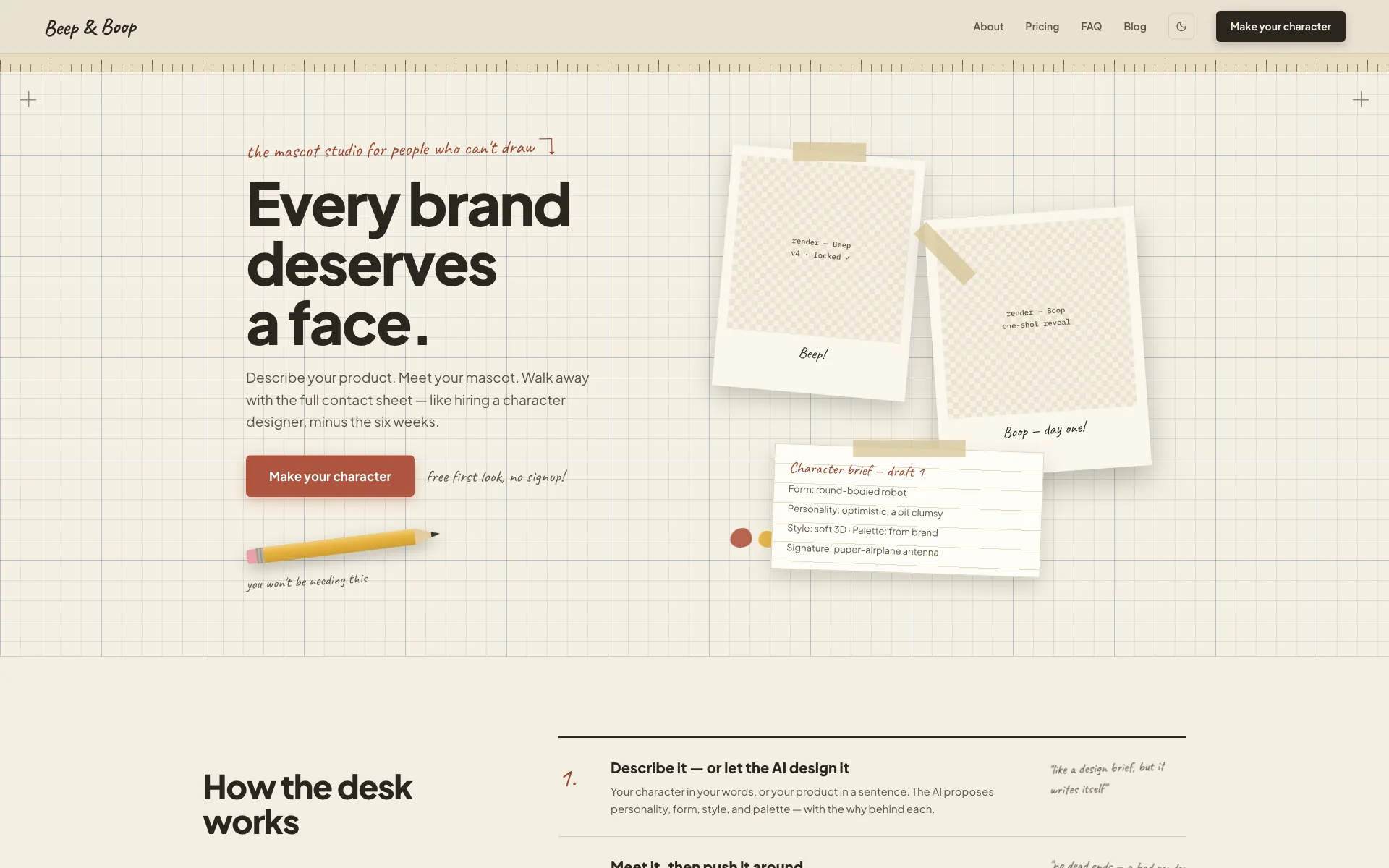
I built Beep & Boop to solve this consistency gap. The platform establishes a structured studio environment where founders can generate a foundational mascot, lock its core visual attributes, and reliably produce a versatile, production-ready asset kit that scales across an entire brand ecosystem.
- Role
- Product designer, builder, and first customer
- Timeline
- July 2026 to present
- Team
- Claude (development)
- Status
- Live with one-time packs at $19 and $34
01 / ORIGIN
Turning character illustration into a predictable system
Before transitioning into product design, I spent significant time drawing characters and studying how a memorable mascot builds brand identity. While modern generative tools make creating a single asset simple, keeping that character recognizable across different poses, expressions, and environments remains exceptionally difficult. I built Beep & Boop to transform this chaotic generation process into a predictable, studio-grade creative workflow.
The platform provides a guided experience accessible to founders who do not possess professional illustration skills or complex prompt engineering knowledge. Users refine a character, lock its core visual properties, and export a complete deliverable kit including twelve distinct poses, transparent backgrounds, and a reusable character sheet. To respect consumer trust, the business model avoids recurring subscriptions in favor of a clear, one-time purchase.
02 / EXPERIENCE
Designing a studio, not another prompt box
I wanted the interface to feel like sitting down at a physical character designer’s desk rather than staring at an empty text field. The guided experience walks users through structural visual choices across five distinct creative layers: character type, illustration style, composition, personality, and theme. Instead of writing complex text prompts, founders build these combinations visually, updating a structured brief that drives the underlying image generation model.
Once a user locks a character design, that asset becomes the definitive reference for all subsequent variations. The system automatically evaluates newly generated poses for structural inconsistencies, triggering automated retries whenever a result drifts too far from the original reference geometry. The interface reinforces this creative studio theme through warm paper textures, digital contact sheets, and polaroid styling to make a digital automation workflow feel creative and tactile.
03 / DECISIONS
Knowing when the details break the flow
Evaluating Beep & Boop as an actual customer exposed critical friction points where individual features worked technically but failed systemically. The initial model implementation split the interface into two separate, competing creation flows rather than a single cohesive experience. I consolidated everything back into a unified guided path. I also discovered that completing a purchase left users stranded on a blank character brief rather than letting them pick up exactly where they left off, a post-purchase handoff error that I quickly corrected to preserve user momentum.
A comprehensive end-to-end audit uncovered deeper transactional dead ends, missing image previews, and leftover template instructions that had survived early implementation phases. Furthermore, the generation sequence lacked a clear conversion path, making it difficult to purchase the complete asset kit after generating a free character preview. These structural details are impossible to catch by analyzing isolated features; they require auditing the entire ecosystem as a first-time user to ensure engineering capabilities translate directly into a checkout and delivery flow that holds together.
Beep & Boop is live with free character previews, structured asset kits, and one-time purchases.
Building the underlying generation system was an engineering challenge, but the primary focus now shifts entirely to strategic distribution. The next step is getting the platform in front of founders and early-stage small businesses, proving that an intentional, system-driven interface can make distinctive brand assets accessible without traditional illustration budgets.
From idea to production, with AI as a collaborator.
I partner with AI across the product lifecycle as a rigorous collaborator. I expect models to challenge my decisions and expose trade-offs, not simply agree with me. While independent agents accelerate our build and verification loops, human governance remains absolute. AI creates massive operational velocity, and my responsibility is ensuring that speed moves the product in the right direction.
Discover
Understand the problem
01 /Step 1: Frame the idea
Problem, audience, desired outcome
02 /Step 2: Explore together
Questions, alternatives, tradeoffs
03 /Step 3: Validate assumptions
Research, feasibility, evidence (AI research - I decide)


Define
Set the direction
04 /Step 4: Define the product
Requirements and success criteria
05 /Step 5: Plan the work
Milestones, tasks, acceptance tests. AI drafts
06 /Step 6: Approve the plan
I revise scope before work begins. My approval.
Deliver
Build, verify, release
07 /Step 7: Build + review loop
Implement, agent audit, fix, recheck (AI and agents)
08 /Step 8: Connect + test
Services, env setup, staging QA
09 /Step 9: Ship + learn
I approve release; we iterate. My approval
If you’re interested in working with me, please contact sincerelyjorge@gmail.com.
Have we met? Let’s connect on LinkedIn. Lurking? See you on X. Either way, thank you for stopping by.